


033 - An Inauspicious Splashdown

"Time and tide weather the Body's vessel, but it is our own choice that decides whether we set sail for adventure or lie at anchor watching life from the harbour"
Sat here typing this blog I want to first say a big “Welcome back to Sawasdeekat”, my personal, and fly-on-the-wall account of our sailing adventures as we (Pookie and I) try to get our catamaran round the world.
We left you last episode in Monfalcone which had been our home, our dusty, industrious nest for the last few months. The gargantuan shipyards, a symphony of clanging steel and sparkling welding torches, had been our backdrop. We’d made peace with its gritty charm, even grown fond of it, a bit like a scruffy, chain-smoking uncle with a heart of gold.
Leaving was a sweet sorrow, a feeling perfectly crystallised in a recent trip to a village outside Udine, where Pookie, my Master-Chef of a wife, had her Thai heritage celebrated in a riot of colour, Thai food and Singha Beer. Pookie had made sure each day that I didn’t lose faith in her cooking (I didn’t). We even managed to find a local metal supplier who crafted us an aluminium support plate for our salon lowering table. We had become nervous that is might not be up to hold both our weights at the same time. A local cushion maker also fashioned us some new cushions and it was ready for being lounged on.
The friendships forged in Monfalcone made our departure feel like tearing a page from a book you’ve loved.
But oh, what a spectacle our leaving was.
The day arrived. Bills were paid, hands were shaken, and Sawasdeekat, our beloved 48-foot catamaran, was cradled in the belly of a leviathan mobile crane. We were lifted, swung with glacial slowness over the yard, and finally lowered towards the water. As we kissed the surface, I’ll admit I performed a hurried, slightly panicked inspection of the rear cabins. You see, one of the saildrives was missing its official rubber seal, a detail that had caused me many a sleepless night.
Would we fill with water like a ceramic sink?
Would we achieve submarine status before we'd even left the marina?
A quick peek confirmed we were, miraculously, buoyant and leak free on both sides. Our sailing friends later opined, with the casual confidence of those not currently sinking, that the SikaFlex sealant used (like a super version of the stuff that keeps your shower tiles from flooding the kitchen below) was probably superior to the Yanmar rubber seal anyway. Reassurance is a wonderful thing, even when it comes in the form of a bathroom caulk.
First panic swatted away. Next, the moment of truth. I took a breath, turned the key, and both engines roared to life. A minor miracle. No vital hoses had been left disconnected, no crucial wires forgotten. Once the thick lifting straps were removed it was time for the sea trial.
With several engineers with me and with the confidence of a man who has, in fact, operated this very boat before, I slowly clicked both throttle controls into reverse.
Nothing.
The boat remained stubbornly, philosophically stationary.
"Più potenza!" cried a chorus of other engineers from the marina wall, waving enthusiastic arms. More power. Right. I nudged the throttles further. What happened next defied the very laws of nautical physics. Instead of reversing, Sawasdeekat decided to proceed, with a gentle and utterly bizarre lurch, forwards and to the left, aiming its freshly polished hull directly for the concrete wall of the launching bay.
Fearing of losing the nose of the boat I snapped the controls back to neutral. My heart was doing a passable impression of a hummingbird.
The engineers, ever encouraging, urged me to try again. I knew my boat. Reverse had always meant reverse. I was now convinced I looked like the star of a maritime blooper reel, the man who couldn't back out of his own parking space. I tried again, this time with what I hoped was a commanding, sea-captain level of "gusto." The same thing happened. Another elegant, unplanned dart towards certain, expensive disaster.
"Nope," I declared, with a calm I did not feel. "Something is definitely not right."
Now, you may recall from our last episode that my faith in the engineering prowess on offer had been.. er… "challenged" by the rubber seal ordeal. To appease me, I’d been given a sheaf of guarantees, both written and verbal, about their unparalleled experience. I could see that same frustration now reflected in their eyes. The grand launch had fizzled.
They swarmed aboard. There was muttering, pointing, and a fair amount of Italian theatrical scratching of heads. Then, the discovery. A discovery so brilliantly simple it was almost an art form. Upon reassembly, one engineer had, in a feat of spectacular inversion, fitted the accelerator linkage on one side of the boat on backwards. So, on the starboard side, reverse was forward, and forward was, presumably, an attempt to launch the boat into the car park. Embarrassed Italian cheeks turned red and the air turned a delicate shade of blue with Italian blasphemy. The error was corrected.
And so, to the not-so-sea, sea trial.
With the issue resolved, I reversed Sawasdeekat into the small bay. I was asked to accelerate, decelerate, turn left, turn right. The engineers observed this ballet for all of five minutes, decided it was "perfetto," and, vanishing like mirages in the afternoon sun, promptly declared it time for a siesta. I learnt later that a post mechanical “sea trial” should have been a proper “work out” for the new sail drives, with thrusting to full capacity and then into reverse, but who were we to know?

As new boat owners, we had no benchmark for adequacy. But with the wind of optimism in our sails and a sad wave to our friends and resident swans, we set off the next day.
Now, a note on catamaran propulsion: some purists use both engines, a symphony of synchronized power. In my humble opinion it also uses twice the fuel. I, a champion of economy in a world without bottomless pits of money, prefer to use one engine at a time.
This is heresy to some, who claim it pulls the boat askew. True, but on a lightweight cat like ours, a mere 5-degree tweak of the helm counteracts it. The strain on the rudders is minimal, and if the sea is pushing you from the opposite side, it can even be an advantage.
So, as soon as we were out of sight of the waving hands and the bay itself, I turned one engine off. We were a one-engine powerboat, setting a course for Croatia!
On our newly serviced engine, we sped along at a respectable clip. The world was beautiful, the sun was shining, and for one glorious hour, we were masters of our own domain. Then the first trial, we approached the marine equivalent of a six-lane motorway: the main shipping lane out of Trieste.
To you land-lubbers, the sea seems a vast, rule-free expanse. It is not. For these behemoths, there are designated marine roadways, deep-water channels where they have the right of way and the momentum of a small asteroid. We looked left towards Trieste. Nothing. We looked right. Clear. We began to cross.
Halfway across (and on the central reservation you might say), we saw it. The Galata Seaways, a roll-on-roll-off cargo ship longer than two football pitches, a floating apartment block charging down its side of the road at 15 knots. I did the maths. We had the space, we had the speed. We could make it. We carried on.
At about a third of the way across this second half, my one, precious, supposedly serviced engine… died.
When you are a 26-foot-wide cork drifting into the path of a 29,000-ton, physically unstoppable object, the world snaps into a hyper-real vividness, almost as if God Himself just tweaked the contrast. The Galata Seaways could no more swerve or stop for us than a glacier could decide to take the day off. I tried to restart the engine. It coughed, spluttered, and gave up the ghost. Pookie, my ever-resourceful Pookie, scrambled for the VHF radio, but that felt like sending a telegram to an avalanche. It was approaching and closing fast.
In sheer, unadulterated desperation, and with no logical reason to believe it would work, I turned the key on the other engine. It roared to life.
I have never moved so fast. I spun the wheel, and our little catamaran leaped out of the path of the oncoming giant like a startled cat. The Yanmar repair of Monfalcone had lasted a grand total of ten miles. Once safely out of the way I slowed down again and made our way back to Monfalcone, our good friend Seigfreid messaged to bid us farewell. Pookie responded with a terse, " Engine failure. Trying to return.”
Now one of the biggest surprises for us has been the charity, kindness and willingness to help that boat owners extend to one another. For Seigfreid was like a knight in shining armour. "I will come and make sure you get back safely," came the reply. I remember looking at his message with some incredulity. For no sooner had he read the message than he was instructing his crew to cast off and fire up the engines in his glorious motoryacht (a Sanlorenzo SD92 called Lady Jane II). This 90-foot floating palace is the epitome of luxury. With hints of art deco in its design, it has shagpile carpets so gloriously thick you half-expect to lose a shoe, if not a toe, with every step. Yet here was Seigfreid, like a maritime guardian angel, driving it like it was a speedboat to make sure we were OK. Marine-life friends are priceless.
Once back in the marina, the Yanmar engineers were summoned. In typical Italian fashion, they could not possibly investigate for two days. When they did, the diagnosis was a masterpiece of the anti-climactic. A fuel cut-off valve, turned off during the service, had never been turned back on. We had been defeated not by a complex mechanical failure, but by a fuel switch. A maritime 'did you try turning it off and on again?' Our faith in the Yanmar engineers had already officially sailed, but had now sunk and was now resting with Davy Jones.

This led to a fascinating, if not terrifying, nautical lesson. Unlike a car, diesel from the fuel tanks in a boat goes to the engine, and any unused fuel is returned to the tanks for another go.
Why? I have no idea.
It’s not how my car works and so was a complete revelation for me. The return pipe from our port engine fed into just one of our four tanks—the very tank with the shut-off valve engaged. The engine had pumped until that tank was full to bursting, then, with no place to put the returning fuel, it simply… stopped. Had the starboard engine’s return line been plumbed to the same tank, we’d be currently decorating the seabed of the Gulf of Trieste.
Sawasdeekat had survived!
But if Lady Luck was merely mischievous before, she now had a full-blown vendetta.
Because due to a G7 conference four days' sail away in Apulia, we had been given new official check out procedures. We now had to formally check out of the Italy. So we went into Monfalcone, expecting a five-minute stamping procedure. Instead we were treated like a security risk, shooed away, and with no clear instructions, told to email. In desperation, and wanting to depart I called a number. The voice on the phone was calm and breezy. "The G7? Ah, don'ta worry about it. Itsa taken care of." My response? WTF!?
Now being British we like to worry about things so we emailed as well just in case. All this is a little ironic given the G7 represents only about 10% of the world's population, yet tries to tackle 100% of its biggest problems. However, keen to be on our way we set off for Rovinj, Croatia, on one engine. We made it past the marine motorway this time but didn’t get far before (would you believe it!) our autopilot promptly disengaged. Once reset, it held, but the message was clear: Sawasdeekat was in a mood.
The sole, shining beacon of good news? Some crazy performance gains! 2400rpm on one engine and we were hitting 6.6 knots! We refuelled in Rovinj, failed spectacularly to attach to a mooring buoy (a comedy of errors best not detailed for the sake of my blood pressure), and instead slunk around the corner to anchor.
We finished the day tired and short-tempered, our grand escape culminating not in a thrilling, movie-style dash for the Swiss border, but in a dismal anchorage that felt like the scene of a foiled prison break. The air was thick with the scent of damp earth and despair. And then there was the water.
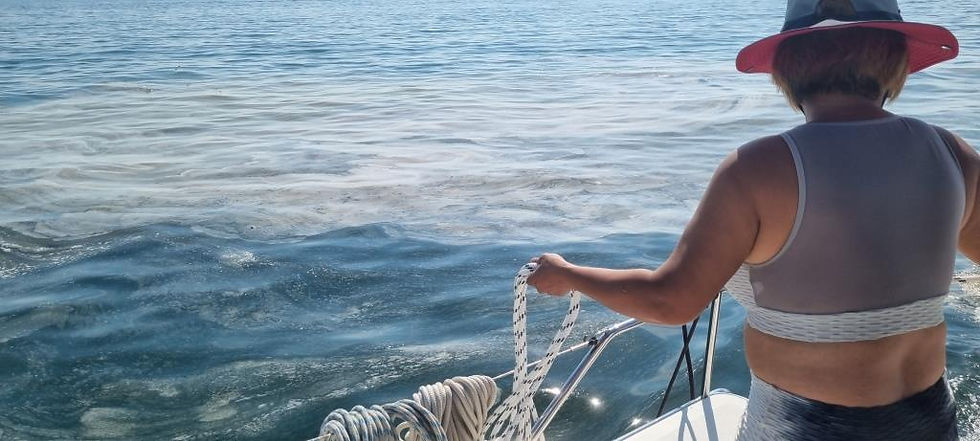
The world around our beloved Sawasdeekat was not water. It was a light brown sludge, a primordial ooze that clung to her once-gleaming hull like a grimy welcome mat. As the sun set, casting a sickly orange glow over the scene, we watched, horrified and yet mesmerized, as things floated past. Things that suggested the local sewage system had, perhaps, also decided to make a grand escape.
But adventure, like a good curry, is often spicier than you anticipate, and sometimes, regrettably, contains ingredients you didn't order. Would Croatia redeem itself? Would our luck finally decide to turn with the tide, or were we destined to become permanent residents of the brown lagoon?
Join us next time to find out what happens in our world of tide and error way.
If you want to view our video of this floating fiasco, please click the link to our YouTube
Until Next week – Tatty Bye!


Comments