


Blog 037 – Warships, forest fires and a Greek Tragedy

OK, maybe I shouldn’t write two blogs one after another because I am still in Monkey Magic mode😊. Now if our journey is a low-budget Monkey Magic remake, then this week’s episode took a sharp turn into a gripping, prime-time medical drama (think ‘Casualty’ but where the entire plot is happening in the waiting room and the scriptwriters, it seems, have no regard for genre consistency).
Kastos Kastos Kastos
When we last left our last episode, we had a freshly fixed starboard engine and dented hull, a fair trade in the economy of Sawasdeekat. We left our friends Eric, Vandy, Nicole, and Trip with a wave, pointing our twin bows further south to the idyllic island of Kastos. The journey was a dream, a montage sequence set to soothing music. We negotiated the beautiful Lefkados Canal, a narrow, tree-lined waterway where the most dramatic moment was an unusual twisting bridge that kindly stopped car traffic just for us. It felt, for a glorious moment, like the world was finally getting out of our way.
Once at Kastos, we were reunited with our good friends Ed, Karen, Mark, and Sally (all of whom we had met in Montenegro). We shared a wonderful meal and caught up on gossip new and old. But as all good gatherings must, ours ended, we parted company, and sailed south into the vast Gulf of Patras. On the way, Pookie, our saintly Tripitaka, continued her divine work of keeping my belly just two pies away from being clinically obese.
@Pookiestylecook @Pookiestylecook 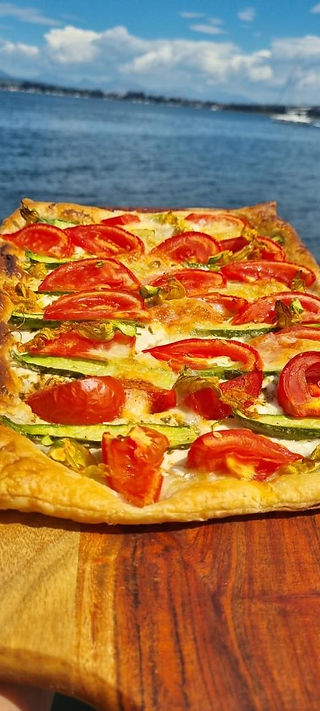
@Pookiestylecook
This is where our episode took its first strange turn. We picked up a tail.
The NATO warship M1090 was at first a speck on the horizon, minding its own business (going in the opposite direction in fact). Then, once past us and with a suddenness that clenches the stomach, it changed course and turned around. It sped up, closed the distance, and then slowed to match our meagre 5-6 knots, following behind us like a not so undercover police car in a TV crime series. For a full hour, this hulking grey behemoth (a vessel designed for hunting submarines, not catamarans named after Thai greetings) mirrored our every move. I felt like Monkey being tailed by a particularly serious celestial bureaucrat – quite unnerving. We carried on regardless and were approaching the magnificent Rion-Antirrio Bridge, a 2,880 metre long engineering marvel. Fun Fact from Ecosia (my chosen search engine because it plants trees), the Gulf of Corinth is actually expanding by about 1.5 cm per year due to tectonic activity (who knew?).
We needed permission to pass underneath, so we veered off to anchor for the night at Macynia. Our NATO shadow followed, only to then decide we were too insignificant to bother with once we were nestled in 6 meters of water. So, without any warning it sped off with a sudden burst of power, like a housecat that, after intently stalking a frightened mouse, gets distracted by a sunbeam.
The next morning, with bridge permission secured, we sailed under the magnificent Rion-Antirrio Bridge and down the Gulf of Corinth.
Rion-Antirrio Bridge Rion-Antirrio Bridge Rion-Antirrio Bridge
Our destination was the legendary Corinth Canal. Now, here’s a fun fact about this 6.4 km long slit through solid rock: when it opened in 1893, it was so narrow that larger ships of the era already couldn't fit through, making it something of a breathtaking but almost immediately obsolete tourist attraction. Our booking was confirmed for the morning, but on the day, we were told of a delay for “maintenance”. So we had lunch in the local town, explored, and finally in the afternoon, we made our descent.
Corinth Canal Corinth Canal Corinth Canal
We nearly didn’t get through and had to assure the canal controller we could easily maintain a steady 5 knots; one can only imagine the traffic jam a slow catamaran would cause in a chasm with near-vertical walls. We took plenty of photo’s of course as this was a most unusual journey.
On the other side, we stopped overnight before making for Ormos Vouliagmenis, a chic bay south of Athens, rumoured to be where Athenian millionaires park their toys. Our fridge, which had been performing a sad, lukewarm shadow of its former-self since Brindisi, was now our top priority. We were on the hunt for a mechanic, a modern-day Pigsy to solve our first-world problem.
And then, the phone rang and the world tilted.
My mum called with the kind of news that turns the Mediterranean sun cold. My dad had cancer and was very unwell. In an instant, Santorini’s stunning views vanished from our minds. We needed to get home.
Now.
What followed was a frantic, soul-crushing scramble. We called, emailed, and begged every marina within a hundred miles for a space. However, it was peak season, and despite our genuine, and urgent need for a marina place for at least 2 weeks, the answer was a universal, robotic "no." The only "yes" came from the Astir Marina, a newly refurbished paradise for billionaires. Our 14.5-metre catamaran was smaller than their guests' tenders. The manager, to his credit, was wonderfully understanding and even offered us a discount.

The discounted price? €650 per NIGHT (Yes I nearly spat out my coffee too!)
We may be living a celestial quest, but our budget is decidedly terrestrial. It was a price tag so astronomical, we half-expected to see Pigsy himself, in a gold-plated hard hat, supervising the docking.
Desperate, we scoured farther afield and found a lifeline in a small fishing harbour on Zakynthos: Agios Nikolaos. The price? A mere €10 a night. The catch? It was 165 miles back the way we came. Without a second thought, we abandoned the fridge hunt, refuelled and set off.
The journey was a blur, a numb transit through a world that, despite the stunning sunsets, had temporarily lost its colour.

We covered 61 miles the first day, stopping at a place called Xylokastro West, which was as forgettable as its name. The only thing that pierced the fog of our worry was the drama unfolding on the hills behind Corinth: a forest fire.
We watched, a great, brooding plume of smoke stained the sky, causing a dark scar on the horizon. And then came the planes. They circled overhead with a low, persistent moan, reminding me of something out of an Auden poem. Mechanical birds of prey engaged in a solemn, desperate ritual. We watched, mesmerised and humbled, as a Canadair CL-415 swooped down, its belly skimming the sea's surface just a few hundred meters from us. In a manoeuvre that lasts barely twelve seconds, it can scoop up an astonishing 6,140 litres of water (the weight of a full-grown elephant) before climbing, heavy and purposeful, to fly towards the inferno.
They dove down again and again into the smoke and flames, a tiny, brave speck against the immense, consuming rage of the fire. It was a stark, and powerful reminder of battles, being fought on fronts other than our own. We anchored for a night, and the following morning, we completed the final 20-mile crossing.
And there it was: Agios Nikolaos. A perfect, tiny harbour with a space just for us. The friendly man on the next boat offered to keep an eye on Sawasdeekat. The following day the harbour master, upon hearing our story, refused all payment because we had apparently eaten at his sister’s taverna the previous night. It was a stunning act of kindness, and a reminder that the smallest ports often have the biggest hearts.
We booked the cheapest direct flights we could find and flew back to the UK.
The days that followed were a different kind of storm, one that no nautical chart could predict and no engine could outrun. The bright Mediterranean sun was replaced by the relentless, sterile glow of hospital lights, which, rather than enhancing, bleached the colour from everything they touched. The cheerful slap of water against our hull was supplanted by the low, anxious hum of hospital machinery and the coded, terrifying jargon of doctors. Words like 'metastasis', 'prognosis', and 'aggressive' landed like physical blows against our hearts.
We existed in a suspended state, a family tethered together by a single, fraying thread of hope. The ward became our new, unwelcome harbour. Its cheap plastic chairs and stale coffee a universe away from the teak decks and sea breezes of Sawasdeekat. We shared smiles that didn't reach our eyes and conversations that carefully navigated around the terrifying 'what if' thoughts, lurking just beneath the surface, like submerged rocks.
My dad, a true fighter, endured his own brutal passage. He was carved into by scalpels, his body mapped by scanners, and his spirit tested by the searing, invisible fire of radiotherapy. He shrank in that clinical bed, seeming to diminish under the weight of it all.
For a while, the man we knew seemed to be receding, his vibrant spirit muted by pain and exhaustion. It felt as if we were watching him slowly drift away from the shore.
But then, a miracle.
Not a sudden, blinding one, but a slow, stubborn dawn. It began with a weak, but recognisable pun that only my Dad could make, whispered through cracked lips. A few days later, a flicker of the old mischief in his eyes when he managed to tease a nurse. The colour, once stolen by the illness and the harsh lighting, began a tentative return to his cheeks, a faint sunrise after the longest night.
He was, against the grim odds and the dire charts, making his way back to us. The current was pulling him back to health. He was, stitch by painful stitch, returning to his old self. The relief that washed over us was not the frantic, engine-revving kind we knew at sea. It was a deep, profound, and quiet tide, the kind that lifts a boat that has been grounded for far too long; setting him gently, gratefully, back afloat the sea of life.
The relief was an emotional tidal wave. Confident he had go over the worst, we knew we had to return to our floating home. The reason? A message from the kindly harbour master in Agios Nikolaos. The metal poles we were tied to had, in a final act of minor sabotage from the water gods, been slowly chewing through our brand-new Italian mooring lines.
Even in a Greek tragedy, the show must go on.
Please subscribe and join us next time as we cancel our Santorini dreams, and turn our bow towards Italy, where a storm of literal, rather than emotional, proportions threatens to send us to a watery finale.
Until then.
"Time and tide weather the Body's vessel, but it is our own choice that decides whether we set sail for adventure on Sawasdeekat or lie at anchor watching life from the harbour" H Tredell


Comments